



Calcium Channel
Ca2+ channels; Ca channels
Calcium channel is an ion channel which displays selective permeability to calcium ions. It is sometimes synonymous as voltage-dependent calcium channel, although there are also ligand-gated calcium channels. Voltage-gated calcium (CaV) channels catalyse rapid, highly selective influx of Ca2+ into cells despite a 70-fold higher extracellular concentration of Na+. Some calcium channel blockers have the added benefit of slowing your heart rate, which can further reduce blood pressure, relieve chest pain (angina) and control an irregular heartbeat.
Calcium Channel Isoform Specific Products
All Product Categories
-
Calcium Channel Inhibitors
(583)
View all products
-
Calcium Channel Agonists
(35)
View all products
-
Calcium Channel Antagonists
(210)
View all products
-
Calcium Channel Activators
(86)
View all products
-
Calcium Channel Modulators
(46)
View all products
-
Calcium Channel Chemical
(1)
View all products
-
Calcium Channel Inducers
(11)
View all products
-
Calcium Channel Controls
(10)
View all products
-
Calcium Channel Ligands
(7)
View all products
-
Calcium Channel Related Products (1225)
Related Products (1225)

-
Antibodies (29)
-
Related Compound Screening Libraries (1)
-
Calcium Channel Isoform Comparison
-
Verapamil-d3
 0 ImagesCat. No.: HY-14275SCAS No.: 152561-91-6Synonyms: (±)-Verapamil-d3; CP-16533-1-d3Verapamil-d3 ((±)-Verapamil-d3) is deuterium labeled Verapamil. Verapamil ((±)-Verapamil) is a calcium channel blocker and a potent and orally active first-generation P-glycoprotein (P-gp) inhibitor. Verapamil also inhibits CYP3A4. Verapamil has the potential for high blood pressure, heart arrhythmias and angina research.
-
Inositol 1,3-bisphosphate sodium
 0 ImagesCat. No.: HY-W788583CAS No.: 208584-52-5Inositol 1,3-bisphosphate sodium is one of the many inositol phosphate (InsP) isomers that could act as small, soluble second messengers in the transmission of cellular signals.
-
Manidipine (Standard)
 0 ImagesManidipine (Standard) is the analytical standard of Manidipine. This product is intended for research and analytical applications. Manidipine is an orally active calcium channel antagonist. Manidipine regulates the expression of cytokines (IL-1β, IL-6). Manidipine has a hypotensive effect. Manidipine can be used in the study of cardiovascular diseases (such as hypertension, myocardial ischemia-reperfusion injury, ventricular hypertrophy), kidney diseases (such as glomerular diseases), and epilepsy.
-
Thapsigargicin
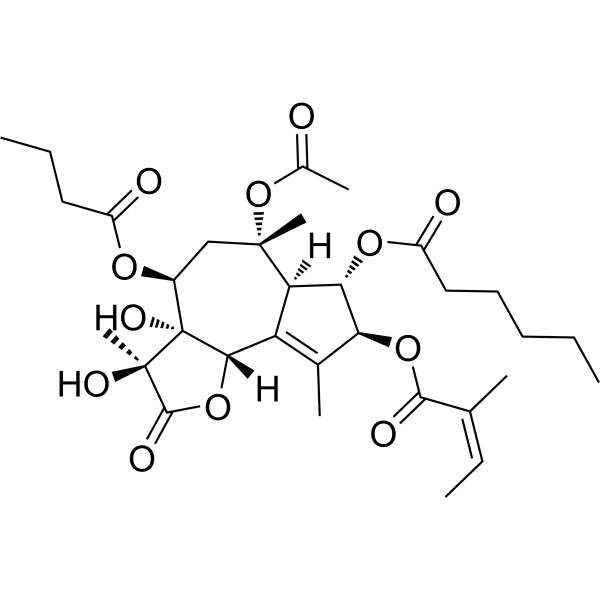 0 ImagesCat. No.: HY-N11691CAS No.: 67526-94-7Synonyms: ThapsigargicineThapsigargicin (Thapsigargicine) is a activator of mast cells and leukocytes. Thapsigargicin induces histamine release from rat peritoneal mast cells and human basophil leukocytes. Thapsigargicin increases the cytoplasmic free calcium level in intact human blood platelets.
-
WMS-1410
 0 ImagesCat. No.: HY-183871CAS No.: 1253197-38-4WMS-1410 is a selective GluN2B-containing NMDA receptor inhibitor with an IC50 of 18.4 nM. WMS-1410 regulates intracellular calcium levels and protects cells from Apoptosis. WMS-1410 inhibits glutamate-induced excitotoxicity. WMS-1410 reverses NMDA/glycine-induced reduction in glucose-stimulated insulin secretion without altering physiological insulin secretion or baseline redox status, but fails to counteract insulin content loss induced by glucolipotoxicity. WMS-1410 exhibits analgesic activity against advanced neuropathic pain. WMS-1410 can be used in studies related to stroke, brain injury, Alzheimer's disease, Parkinson's disease, type 2 diabetes, and neuropathic pain.
-
CGP 28392
 0 ImagesCat. No.: HY-118136CAS No.: 89289-93-0CGP 28392 is an activator for calcium channel, and reactivates the oxygen evolution in calcium-deficient photosystem II (PS II) particles.
-
CERM11956
 0 ImagesCat. No.: HY-108981CAS No.: 97631-49-7CERM11956 is a potent anti-ischaemic agent. CERM11956 is a derivative of bepridil(HY-16952).
-
ML218 (Standard)
 0 ImagesCat. No.: HY-103309RCAS No.: 1346233-68-8ML218 (Standard) is the analytical standard of ML218 (HY-103309). This product is intended for research and analytical applications. ML218 is a potent, selective and orally active T-type Ca2+ channels (Cav3.1, Cav3.2, Cav3.3) inhibitor with IC50s of 310 nM and 270 nM for Cav3.2 and Cav3.3, respectively. ML218 inhibits the burst activity in subthalamic nucleus (STN) neurons. ML218 has no significant inhibition of L- or N-type calcium channels, KATP or hERG potassium channels. ML218 can penetrate the blood-brain barrier.
-
Manidipine dihydrochloride (Standard)
 0 ImagesSynonyms: CV-4093 (Standard)Manidipine (dihydrochloride) (Standard) is the analytical standard of Manidipine (dihydrochloride). This product is intended for research and analytical applications. Manidipine dihydrochloride is a third-generation, lipophilic, orally active and highly vasoselective calcium channel antagonist (IC50 = 2.6 nM in guinea-pig ventricular cells) and acts as an antihypertensive agent. Manidipine effectively reduces blood pressure as well as improving insulin sensitivity, renal protection, and antiatherosclerotic activity. Manidipine also exerts anti-inflammatory activity mediated by NF-κB and antiviral activity against many flavivirus and negative-strand RNA viruses through the inhibition of calcium channel. Manidipine is widely applied to research of cardiovascular, metabolic disease and infection.
-
Levamlodipine besylate Hemipentahydrate
 0 ImagesCat. No.: HY-14744DCAS No.: 884648-62-8Levamlodipine besylate Hemipentahydrate is an orally active L-type calcium channel blocker and MMP-9 modulator with high permeability and retention properties. Levamlodipine besylate Hemipentahydrate significantly enhances plaque stability and improves lipid profiles by reducing blood pressure, decreasing systolic blood pressure variability, and inhibiting MMP-9 expression in atherosclerotic plaques. Levamlodipine besylate Hemipentahydrate not only alleviates cardiac and aortic hypertrophy and prevents renal atrophy, but also produces synergistic effects in blood pressure reduction and organ protection when combined with bisoprolol (HY-129029). Levamlodipine besylate Hemipentahydrate exerts no significant inhibitory effect on abdominal aortic intimal hyperplasia. When excessively accumulated in the epidermis, Levamlodipine besylate Hemipentahydrate may induce changes in keratin structure, impair the skin barrier and trigger inflammation; long-term use further exacerbates skin irritation caused by local administration. Levamlodipine besylate Hemipentahydrate can be used in research related to hypertension and atherosclerosis.
-
(R)-Lercanidipine
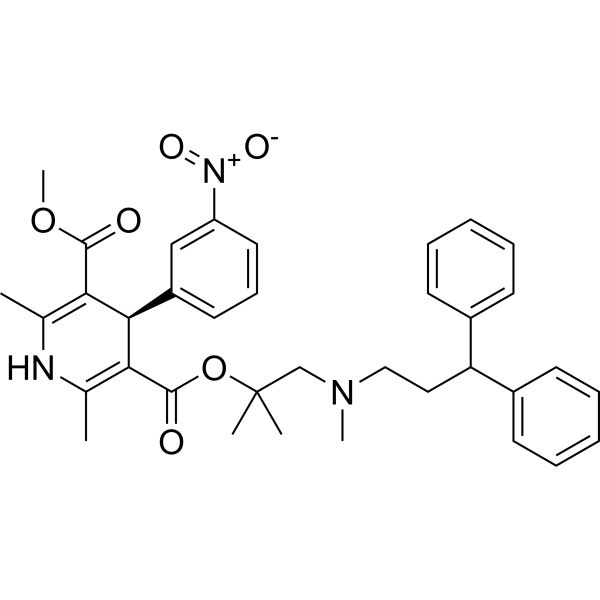 0 ImagesCat. No.: HY-B0612CCAS No.: 185197-70-0(R)-Lercanidipine is the R-enantiomer of Lercanidipine. (R)-lercanidipine is a calcium channel blocker.
-
Cilnidipine-d4
 0 ImagesCat. No.: HY-17404S1Synonyms: FRC-8653-d4
-
Almorexant (Standard)
 0 ImagesCat. No.: HY-10805RCAS No.: 871224-64-5Synonyms: ACT 078573 (Standard)Almorexant (Standard) is the analytical standard of Almorexant. This product is intended for research and analytical applications. Almorexant (ACT 078573) is an orally active, potent and competitive dual orexin receptor antagonist, with Kd values of 1.3 nM (OX1) and 0.17 nM (OX2), respectively. Almorexant reversibly blocks signaling of orexin-A and orexin-B peptides. Almorexant totally blocked the intracellular Ca2+ signal pathway. Almorexant stimulates caspase-3 activity in AsPC-1 cells and induces apoptosis .
-
D-myo-Inositol-1,4,5,6-tetraphosphate sodium
 0 ImagesCat. No.: HY-W794363CAS No.: 157542-47-7D-myo-Inositol-1,4,5,6-tetraphosphate sodium is one of several different inositol oligophosphate isomers implicated in signal transduction.
-
Dronedarone (Standard)
 0 ImagesSynonyms: SR 33589 (Standard)Dronedarone (Standard) is the analytical standard of Dronedarone. This product is intended for research and analytical applications. Dronedarone (SR 33589), a derivative of amiodarone (HY-14187), is a class III antiarrhythmic agent for the study of atrial fibrillation (AF) and atrial flutter. Dronedarone is a potent blocker of multiple ion currents, including potassium current, sodium current, and L-type calcium current, and exhibits antiadrenergic effects by noncompetitive binding to β-adrenergic receptors. Dronedarone is a substrate for and a moderate inhibitor of CYP3A4.
-
HA-1004 dihydrochloride
 0 ImagesCat. No.: HY-123468ACAS No.: 92564-08-4HA-1004 dihydrochloride is a selective inhibitor of PKA, which can inhibit lipolysis and induce vascular relaxation. HA-1004 dihydrochloride is also a dual inhibitor of cyclic GMP-dependent protein kinase and cyclic AMP-dependent protein, and is involved in smooth muscle, second messenger, cyclic AMP and cyclic GMP regulation mechanisms. HA-1004 dihydrochloride is an antagonist for calcium, that can be used as a vasodilator to inhibit the contraction of rabbit aortic strips, or to antagonize ERK and tyrosine hydroxylase (TH) phosphorylation in morphine abstinence rat models.
-
Gabapentin hydrochloride (Standard)
 0 ImagesCat. No.: HY-A0057ARCAS No.: 60142-95-2Gabapentin (hydrochloride) (Standard) is the analytical standard of Gabapentin (hydrochloride). This product is intended for research and analytical applications. Gabapentin hydrochloride is a potent, orally active P/Q type Ca2+ channel blocker. Gabapentin hydrochloride inhibits neuronal Ca2+ influx and reduction of neurotransmitter release. Gabapentin hydrochloride is a GABA analog that can be used to relieve neuropathic pain.
-
PD 122860
 0 ImagesCat. No.: HY-124229CAS No.: 122576-86-7PD 122860 is a calcium channel blocker. PD 122860 also can stimulate sodium channel. PD 122860 can be used for the research of cardiovascular and cerebrovascular diseases.
-
Wilforgine (Standard)
 0 ImagesCat. No.: HY-N1072RCAS No.: 37239-47-7Wilforgine (Standard) is the analytical standard of Wilforgine. This product is intended for research and analytical applications. Wilforgine is a bioactive sesquiterpene alkaloid in Tripterygium wilfordii Hook. F. Wilforgine can induce microstructural and ultrastructural changes in the muscles of Mythimna separata larvae, and the sites of action are proposed to be calcium receptors or channels in the muscular system.
-
Saquinavir-13C6
 0 ImagesCat. No.: HY-17007S2Synonyms: Ro 31-8959-13C6Saquinavir-13C6 (Ro 31-8959-13C6) is 13C labeled Saquinavir (HY-17007). Saquinavir (Ro 31-8959) is an orally active HIV protease inhibitor that can be used in the research of AIDS. Saquinavir also has anti-inflammatory activity and can induce apoptosis of human red blood cells.




